

Integrated Regenerative Design is a professional design and development framework that enables designers and implementers to work together using integrated and transdisciplinary approaches to create projects, products, and processes that regenerate ecosystems, create vibrant communities, and revitalize local economies.
Works For Any Type of Technology
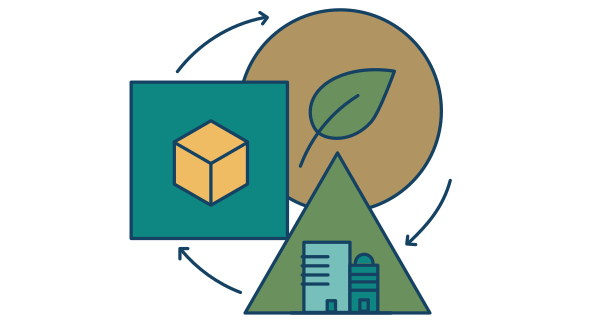
Integrated Regenerative Design (IRD) is structured to support the design of just about any category of human technology, from large-scale infrastructure and buildings, to consumer electronics and textiles, to business practices and industrial processes.

Scales With Any Project
IRD provides a robust framework that can scale to any size project including those that involve design professionals from across the entire array of trades and design disciplines.

Enables Large-Team Collaboration
IRD was created to allow large teams to work together on complex projects, producing systems that function as mutually symbiotic parts of the ecosystems in which they are embedded.

Creates Ecosystem-Inspired Designs
The IRD Framework contains nine major components that all work together to enable teams to create designs that work like ecosystems, ultimately helping to create the desired quality of life
for everyone involved.
What makes the
IRD Framework unique?

Real Metrics, Not Greenwashing
The framework provides technically precise and rigorous definitions of the concepts of regenerative and sustainable that are based on thermodynamics and the regenerative dynamics of living systems, allowing for a realistic and accurate assessment of how well systems actually meet these standards.

Truly Transdisciplinary
The framework was designed from the ground up to help design professionals break out of traditional disciplinary silos to work in whole-systems teams that focus on the entire picture instead of isolated parts.

Compatible With Life
The framework doesn’t get trapped just focusing on the attributes of the technologies or systems being designed, but addresses the bigger picture of how that design interacts with the ecosystems that surround it and how the design supports the health and happiness of the individuals and communities that it supports.
Holistic Context
Every project, product, or process that humans design exists in a larger ecosystemic and cultural context. Systems that create a web of beneficial interrelationships with everything around them increase the likelihood that they will be resilient and sustainable.
Every design begins by establishing the holistic context of the project, with these core parameters:
Purpose
Clearly states the purpose of the project, why it is important, and what regenerative outcome it seeks to provide for the community it supports
Quality of life
Works with all stakeholders to create a Quality-of-Life statement that clearly outlines the quality of life the design hopes to create for everyone affected
Boundaries
Identifies the boundaries of the system under design, including the internal and external stakeholders, all other living systems affected, the existing resource base, and how that resource base will be stewarded to maintain and regenerate it over time
Connection
Identifies the ways in which the project will connect with the systems around it and how it will support the health of the larger systems into which it is embedded.
Metrics
Defines the metrics that will be used to measure the success of the design
Ethics
The ethics behind most design approaches are usually unspoken, implicit, and unexamined.
The problem is that any design process involves making fundamental ethical decisions about who benefits and who ends up paying for the system being designed. Ignoring the ethical dimensions of design doesn’t make them go away.
The IRD Framework meets this challenge by adopting an explicitly stated set of ethics that help guide the decision-making process, requiring that the outcomes and costs be fully examined instead of hidden or externalized.
The four core ethics of IRD are:
Design For Earth
All our designs will care for and regenerate the natural ecosystems directly affected by it while producing either neutral or regenerative outcomes for all other ecosystems.
Design For People
All our designs will care for and nurture all internal stakeholders while producing either neutral or positive outcomes for all external stakeholders, including individuals, communities, and cultures.
Design For the Future
All our designs will strive to produce outcomes that are in ecological context with and a balanced part of the larger ecosystem, limiting their scale and resource flows to levels that allow regenerative outcomes indefinitely into the future.
Integrity & Transparency
All aspects of our work, including communication, research, funding, collaboration, design, implementation, and operation, will be performed with integrity and transparency, in an environment supporting fairness for everyone involved, working in the best interest of all the living entities that will be affected, and with an honest assessment of the impact for 500 years into the future.
Holistic
Decision
Making
Decision-making in complex projects can often be somewhat ad hoc and often fails to include the voices of all stakeholders.
The holistic decision-making approach used in the IRD framework creates a clear road-map for making complex decisions that produce regenerative outcomes while honouring the input of everyone affected.
The Holistic Decision-Making approach used by the IRD framework:
- Establishes clear decision pathways and assigns decision-making responsibilities
- Develops the design documents, implementation plan, and operations plan simultaneously, defining which parties will be responsible for which aspects of the system design, implementation, operation, maintenance, and decommissioning
- Actively identifies and manages risk
- Isolates the root-cause issues behind problems
- Provides testing questions used to evaluate all major decisions
- Establishes methods of continuous monitoring and adjustment throughout the entire lifecycle
Biocompatible Design Standard
The Biocompatible Design Standard is a technical standard that provides a coherent set of principles, objectives, and guidelines for creating human technologies that are resilient, sustainable, and deeply compatible with life.
The Biocompatible Design (BCD) approach lays out a new pattern language for technological development, creating a roadmap for future advancements in regenerative design.
Because of its structure and breadth, the BCD Standard can act as a sort of meta-standard that can be used to inform the development of more domain-specific standards, encouraging a shift in an array of industry standards towards a more whole-systems and biocompatible approach.
Communications
and Collaboration
Melvin Conway coined what became known as Conway’s Law by observing that organizations that design systems will aways produce systems that are copies of their own internal communications structure.
The obvious implication is that no organization can design a regenerative system unless its own internal communications structure is also regenerative.
The IRD Framework provides a complete set of regenerative communications and collaboration tools that allow for distributed decision-making while also ensuring that critical whole-systems decisions are addressed quickly and efficiently by special transdisciplinary working groups, maintaining a dynamic balance between empowering distributed teams and creating whole-system agreements across the entire scope of the project.
The communication and collaboration tools of IRD create an organizational structure that dynamically changes and adapts as the project unfolds, allowing resources to be dynamically reallocated as needed for each developmental stage.
This organizational structure is designed to scale up or down with the needs of each design, and can even act as an overlay that allows dozens of different companies to collaborate seamlessly on large-scale projects.
Regenerative Design Method
Creating regenerative and biocompatible designs requires a fundamentally different approach to the process of design than is typically taught in most universities and professional training programs.
While many of these programs provide excellent domain-specific knowledge and tools, they lack both a whole-systems perspective and a set of regenerative design methods that can put that knowledge to work effectively to create sustainable and biocompatible outcomes.
The IRD Framework augments the existing domain-specific knowledge of professionals across a wide range of disciplines by providing them with the training to put that knowledge to work in new ways, equipping them with an array of powerful regenerative design tools and methods.
The courses and curriculum offered by the Institute of Integrated Regenerative Design are specifically designed to teach both this set of regenerative design methods and the skills required to put them to work in real-world projects.
Ecosystemic Economic Model
In order to succeed, any approach to regenerative design must align with the set of incentives and constraints created by the economic system inside of which it operates.
The challenge is that the current dominant economic model doesn’t have any way to adequately account for the
real value of the living ecosystems that allow it to exist.
The models found in modern economics textbooks contain several unspoken assumptions that are legacies from the early development of economic theory, including the idea that nature could be treated as an infinite source of resources and an infinite sink for waste.
This simplifying assumption was made several centuries ago, when the scale of human technology was still small enough for this approach to be a practical solution for the difficult problem of accounting for the value of Earth’s biosphere. By assuming Earth’s resources to be effectively infinite, the value of the resources extracted from nature and the cost of dumping waste into the environment could be mostly ignored.
By the turn of the twenty-first century, the approach of ignoring the value of Earth’s biosphere in our systems of economic accounting was deeply embedded in the modern economy, creating a system of incentives that cannot account for the increasingly limited and stressed resources on which our entire economies depend.
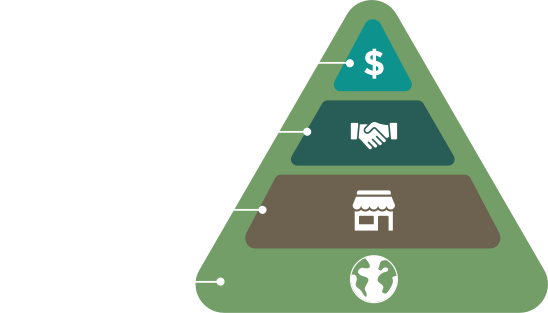
To address this issue, the IRD Framework uses the lens of an Ecosystemic Economic Model, in which Earth’s biosphere is treated as the primary economy from which all other value is derived.
This approach allows for the emergence of an entirely different set of incentives and constraints that account for both the value of in-tact ecosystems and the costs of damaging or destroying them.
Using an Ecosystemic Economic Model, working with nature to sustain and regenerate the living world is acknowledged and accounted for as the building of real and primary wealth.
Ecosystem Regeneration
Every human technology depends upon the Earth’s biosphere to provide the energy, resources, and environment that make it possible. The IRD Framework addresses this reality by making the regeneration of the Earth’s wildlands an integral part of any design project.
The IRD approach to Ecosystem Regeneration includes:
Regenerative land-use patterning
Creating patterns of land use that support the proper balance of wildlands, agroecological lands, and human settlements
Remediating biocides and toxins
Using techniques such as bioremediation to clean up environments that have become polluted
Regenerating hydrology
Restoring both small and large hydrologic cycles, recharging groundwater, restoring free-flowing streams and rivers, ponds, wetlands, and springs
Supporting healthy soil and air
Helping ecosystems build rich soil and create conditions that produce clean air and a stable climate
Regenerating forests, prairies, and other critical habitats
Working with local ecosystems to support the emergence of an ecologically-appropriate mosaic of biomes and ecotones
Restoring and maintaining all trophic layers
Working towards the complete rewilding of ecosystems, including the restoration of the entire network of life, from the smallest members of the environmental microbiome up to the largest megafauna
