

Become a Research Partner.
Learn IIRD's Transdisciplinary & Holistic Approach.
Along with its primary mission of providing world-class education in regenerative design, the Institute of Integrated Regenerative Design (IIRD) also conducts both independent and collaborative research that supports regenerative design practice as scale.
How We Conduct Regenerative Design Research
A whole-systems approach to research.
IIRD aims to compliment the narrowly-focused, domain-specific approaches to research traditionally taken by most academic institutions through a whole-systems approach to research that breaks out of the disciplinary silos that often limit the ability to address the complex, emergent problems facing modern civilization. The Institute’s research projects are chosen to work on the kinds of problems that require transdisciplinary collaboration, allowing researchers who have often never talked to each other before to partner in new and powerful ways.
Leading Research on the Integrated Regenerative Design Framework.
For research that is directly focused on the development of the Integrated Regenerative Design framework of the Biocompatible Design Standard, IIRD most often either conducts independent research or acts as the lead in a research partnership with universities or other nonprofits. The Institute is set up to appoint its own Principal Investigator (PI) and to handle all accounting and reporting tasks associated with advanced research.
Collaboration Beyond Academic Silos.
For broader research topics, IIRD can flexibly partner with universities and other research institutions, setting up a variety of arrangements to support a PI from another organization or to act as a Co-PI. One typical arrangement is for a research university to ask IIRD to partner with them to conduct research that requires a transdisciplinary team to work together effectively, leveraging IIRD’s expertise in whole-systems approaches and effective collaboration that breaks
out of existing academic silos.

The goal is to advance regenerative design globally.
Outputs include peer-reviewed papers, professional standards, white papers, books, and formal documentation of applied methodologies.
Beyond producing its own body of work, the Institute seeks to influence the broader research landscape. One of our long-term goals is to help catalyze a shaft within academic and applied research institutions towards more regenerative, whole-systems framing across disciplines. By addressing complex problems by partnering with natural systems instead of trying to work against them, IIRD aims to contribute to a research culture that is better aligned with the realities of ecological limits, social complexity, and the urgent need for regenerative solutions
that scale to meet growing challenges.
Current Projects
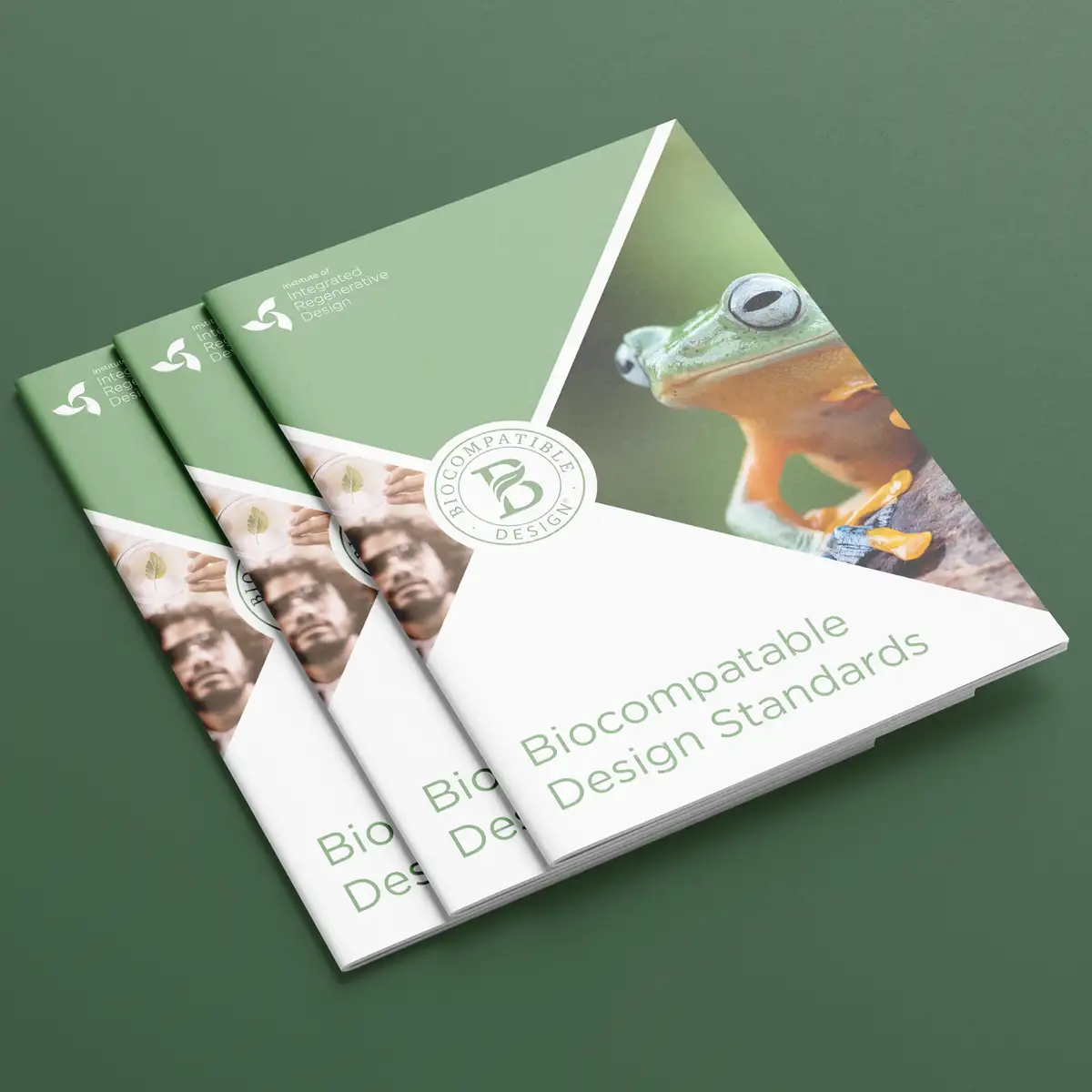
Biocompatible Design Standard Pilot Release
The pilot release of the Biocompatible Design Standard is currently in the final phases of preparation, with the final text of the draft standard having been completed.
The final tasks are completing the literature review so that the list of supporting references can be completed and verified, and finishing the page layout tasks that will allow us to release the standard in an easy-to-read and accessible form.

Dynamics of Sustainable and Regenerative Holons Book
The Dynamics of Sustainable and Regenerative Holons is an upcoming book by Alan Booker, our founder and Executive Director. This work will lay out the technical foundations for a technically-rigorous way to define the concepts of regenerative and sustainable, allowing for the creation of concrete and measurable metrics of system performance that will help move regenerative design from a poorly-defined concept to a technically precise and measurable approach that can be applied at large scale.
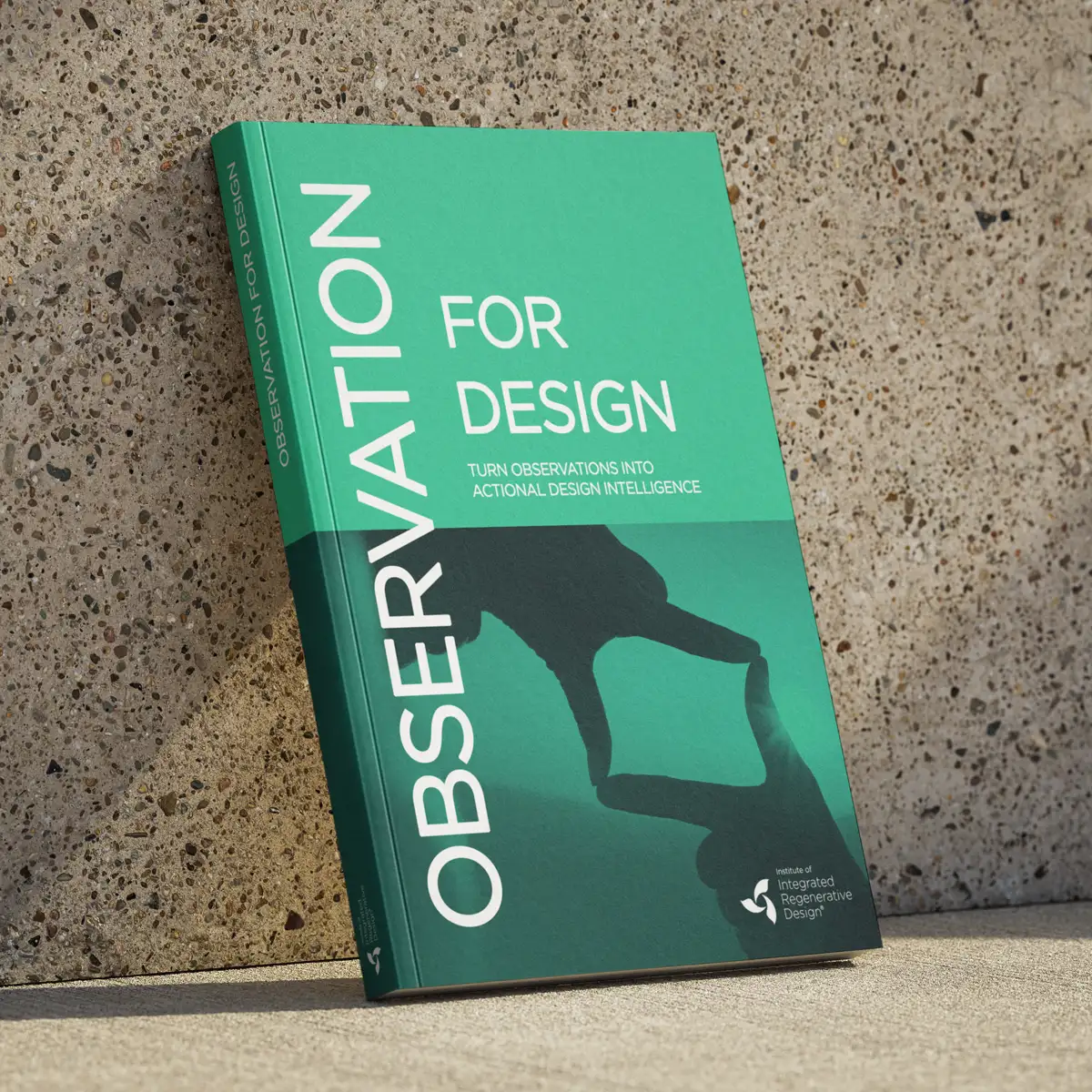
Observation for Design
Course and Textbook
Another book under development by our team, with Alan Booker as the lead author, is Observation for Design. This textbook, along with the design for the accompanying course, arises from Alan’s experience that many professionals lack the fundamental skills of observation
that enable them to create designs that work with the natural environment instead of against it.
This 14-week course, which is also designed to be offered by universities, centers around daily field work that includes field observations, journaling, mapping, and sketching. Students meet
weekly to practice presenting their observations to their team, helping them learn to turn their observations into actional design intelligence.
Partnering with IIRD
If your organization is interested in partnering with IIRD for a research project, please contact us directly via the form below.
